
How to Check Criminal History in Aguilar
Start an Aguilar criminal history search by naming the record, not merely the person. Town Hall routes requests for town documents and municipal material. A report about an incident or arrest may instead belong to the Las Animas County Sheriff's Office. A filed misdemeanor or felony belongs to Combined Court in Trinidad. The Colorado Bureau of Investigation holds fingerprint-supported Colorado history. These are separate files, so checking more than one source is often necessary.
Use this sequence to keep the search tied to an official custodian:
- Ask Aguilar Town Hall whether its clerk holds the municipal item.
- For an incident or arrest report, contact the sheriff unless Town Hall identifies another agency.
- Check the state docket for a scheduled county hearing.
- Ask Combined Court for the register, disposition, orders, or a certified copy.
- Use CBI's ICHC when a broader Colorado-only name history fits the need.
Aguilar Town Records Start Here
Aguilar's official government page lists Town Hall at 101 W. Main Street, Aguilar, CO 81020, phone 719-941-4360, and fax 719-941-4395. Town Clerk Stephanie Coca is listed at aguilarclerk@gmail.com. The page links a Record/Document Request Form and identifies town judge and court-clerk functions, but it does not expose a stable separate case portal or detailed court-field inventory.
The official capture shows Aguilar's public starting point.
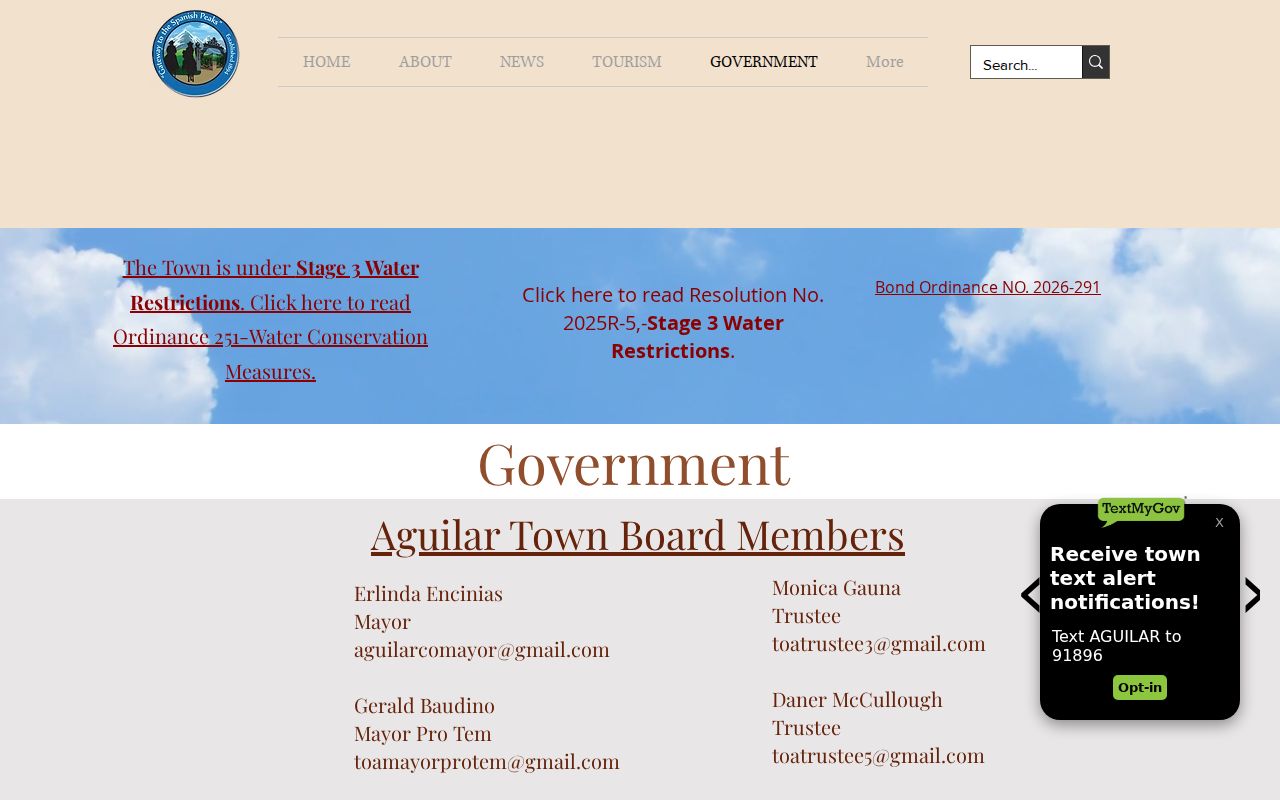
Use the clerk for town records, then move to the sheriff or Combined Court when the item arose from criminal-justice work.
Describe the Aguilar document narrowly. Give a date range, subject, and known file reference. Ask whether the clerk treats it as an administrative or court record. A broad request for every record about a name may not identify a file the town created. If the clerk routes the matter elsewhere, note the office and repeat the same identifiers with that custodian.
The Aguilar Police Record Gap
No official evidence of a separate Aguilar police portal, holding facility, or online criminal lookup was located. This is an access finding, not proof that no local arrangement exists. Ask Town Hall which agency handled a specific event. When it identifies the sheriff, seek the report from the Las Animas County Sheriff's Office.
LASO publishes a written request route at rsantistevan@lasosheriff.org and receives visits at 2309 E. Main Street in Trinidad. Helpful details include the report number, date and time, location, names involved, and a short description. If no reply comes within five business days, call 719-846-2211. Protected material may be redacted or withheld.
Aguilar Records Need the Right Custodian
Sending every request to the town clerk is a common mistake. The clerk routes municipal documents. The sheriff keeps releasable reports and jail files it created. Combined Court keeps filed charges and outcomes.
| Aguilar record | First contact | What it establishes |
|---|---|---|
| Town document | Aguilar Town Clerk | Official municipal file |
| Incident or arrest report | Arresting agency or LASO | Agency action and narrative |
| Current booking | County jail | Custody on the roster date |
| Filed case | Combined Court | Charges, orders, and outcome |
A blank answer from one office does not prove no Aguilar record exists elsewhere.
Arrests and Bookings in Aguilar
No official Aguilar holding facility was found. For a current Aguilar booking, use the Las Animas County Jail at the Garcia Justice Center. The sheriff-linked roster is an index of dated PDF rosters, not a live name-search database. Open the relevant date, then call 719-846-2211 when custody status must be current.
The arresting agency creates its report, while the jail creates a booking file. A prosecutor later decides whether to file charges. Delay between those steps explains why an Aguilar roster entry may appear before a court hearing. A booking proves custody, not guilt, and must not be called a conviction.
The daily roster index has View and Download controls for each dated PDF and offers a subscription route. It is best searched by date, especially when the arrest date is known. A roster may show a person held on more than one basis, such as a new charge and a hold. Call jail staff rather than inferring the current basis or bond from an older Aguilar PDF. Bond information can also change after the first court appearance, so the active case and jail source should be checked on the same day.
Aguilar's Three-Stop Record Trail
Follow an Aguilar event in order: seek the agency report, check county custody, then obtain the court outcome. A person may be released without a local filing, held for another jurisdiction, or appear in court after a roster posts.
Practical trail: Aguilar incident › arresting-agency report › Garcia Justice Center booking › prosecutor review › Las Animas Combined Court case.
The county arrest history page has fuller roster detail. Dates, report numbers, and case numbers help link the same Aguilar event across sources.
Aguilar Municipal Court Records
Aguilar's government page identifies town judge and court-clerk areas, but no stable online municipal case search was found. Ask Town Hall whether the matter is a town or ordinance item. Do not use Trinidad's municipal portal as if it belonged to Aguilar. State misdemeanors and felonies proceed through Las Animas County Court or District Court.
| Court Name | Town of Aguilar municipal court function; verify with Town Hall |
|---|---|
| Case Types Heard | Town-level matters as confirmed by the clerk |
| Case Lookup Channel | Town Hall or court clerk; no stable online portal located |
| What the Docket Shows | Ask which register, event, order, or disposition is available |
| Copies & Fees | Confirm current format, certification, and charges before ordering |
Search Aguilar Cases by Hearing
The Colorado Judicial Docket Search can locate scheduled hearings in Las Animas County. It requires at least one filter besides date. Results may show a name, case number, hearing type, location, appearance type, and courtroom.
This is a calendar, not an Aguilar criminal history database. It omits charging papers, the full register, disposition history, sentences, and documents. After finding a likely event, call Combined Court at 719-846-3316 or visit 200 E. First Street, Room 304, Trinidad. The counter opens weekdays from 8 a.m. to noon and 1 to 4 p.m. It closes at noon and accepts no fax filings.
Provide the case number when possible. Local formats can include CR for a district criminal matter and M for a misdemeanor, but a code does not state the exact offense or outcome. Ask for the charging document and judgment instead of guessing. A hearing marked virtual, in person, or blank describes that event's format, not whether an Aguilar charge was proved or dismissed.
Where Aguilar Records End Up
An arresting agency creates the first Aguilar report. A fingerprinted arrest can reach CBI and become an arrest cycle in CCIC. The jail separately records booking and custody. If prosecutors file, County Court generally handles misdemeanors and District Court handles felonies.
Record flow: Aguilar event › arresting agency or LASO › Las Animas County Courts › Colorado Bureau of Investigation.
Combined Court should report the outcome to CBI. Delay, an older file, or an unmatched identifier can leave the state result without that outcome. Obtain the court disposition and use CBI's challenge process when sources disagree.
For a recent Aguilar event, the agency and jail sources are usually closest in time. For the legal result, the court file has more weight. The register lists case events, while the complaint or information identifies the filed allegations and the judgment states the result. CBI is useful for a broader Colorado view, but an ICHC entry can omit the disposition until the sources are matched. Comparing the arrest date, court case number, and identifying data is safer than relying on the same spelling of a name.
Aguilar Records Show Different Controls
A 2025 CBI announcement concerning an Aguilar public-corruption investigation described a segregated town project account and authorized access. It should not be used to imply guilt or to name the accused here. Its narrower records lesson is that town administrative controls, agency investigative files, and court cases are distinct sources.
The official CBI source supplies that context.
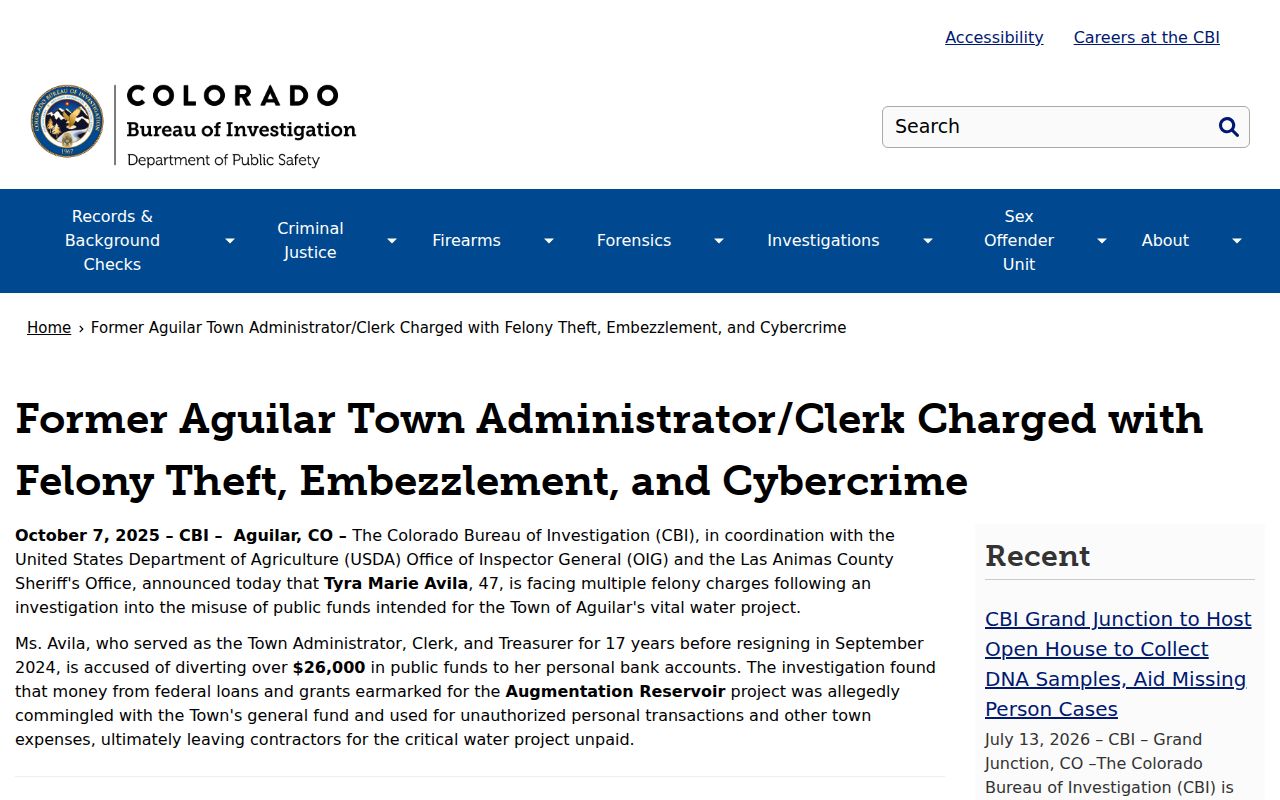
The image underscores why an Aguilar request must identify whether it seeks a town file, an investigation, or a filed case.
Aguilar State History Is Different
CBI's Internet Criminal History Check System provides a Colorado-only name and date-of-birth search. It costs $6 per result and cannot be notarized. Manual CHRI costs $13 and may be notarized. This state service is separate from Aguilar Town Hall.
ICHC excludes sealed records, juvenile arrests, and traffic arrests made when the person was under sixteen. It is not an FBI check. No result does not rule out an Aguilar report, town matter, federal case, out-of-state event, or sealed record. A same-name result is not positive identity without fingerprints. CBI provides fingerprint-based review of one's own Colorado history through approved CABS vendors.
When CBI shows an Aguilar arrest but no outcome, obtain the court disposition first. CBI provides challenge and disposition-update routes for incomplete history. A dismissal does not by itself erase an agency report or booking PDF. Colorado adult relief is generally called sealing, while expungement chiefly applies to qualifying juvenile records. Confirm eligibility with the filing court or a Colorado lawyer.
Public Access Rules for Aguilar Records
Aguilar town records and criminal-justice records use different access rules. CORA fits town administrative files. CCJRA more specifically governs sheriff and police material. Court files also follow Judicial Branch rules. Active investigations, victim information, juvenile files, sealed cases, and personal identifiers may be protected or redacted.
Key Statutes:
Colorado Open Records Act, C.R.S. §§ 24-72-201 through 206 governs access to public records held by state and local bodies.
Colorado Criminal Justice Records Act, C.R.S. §§ 24-72-301 through 309 governs criminal-justice records and permits specified protections.
Chief Justice Directive 05-01 access guidance explains that filed documents come from the filing court and remain subject to protection.
Ask for the legal basis when access is denied, and give narrow identifiers so staff can locate the Aguilar record without exposing unrelated data.
CORA does not turn confidential criminal-justice material into a public town record. Likewise, CCJRA does not promise release of every sheriff narrative. A useful Aguilar request asks for a named document and allows lawful redaction. If the office denies access, request the cited ground and ask whether a less restricted portion can be released. Court sealing can also remove a case from public view, so a missing public result must not be treated as proof that the underlying event never occurred.